


Tandem: Collaborative Agent Canvas
Recently I have been building Menagerie a tool for dispatching many Claude Code agents to complete tasks in parallel while maintaining visibility of progress, status and outputs. agents can show you what they are doing to the web app via playwright and ask for help when the need it.
I think the future of engineering will be based on creating robust agentic systems and amid all the doom and gloom that can exist in the industry these days I want to paint a positive picture of the exciting engineering problems that actually lay ahead of us.
Along with this I'll describe what it has taken me to deploy a system like this, e.g. sandboxing, cursor compatibility, terminals over the network and also how i've made it fun to use (for example you can give your agent a cute avatar, and if you so choose also a top hat)
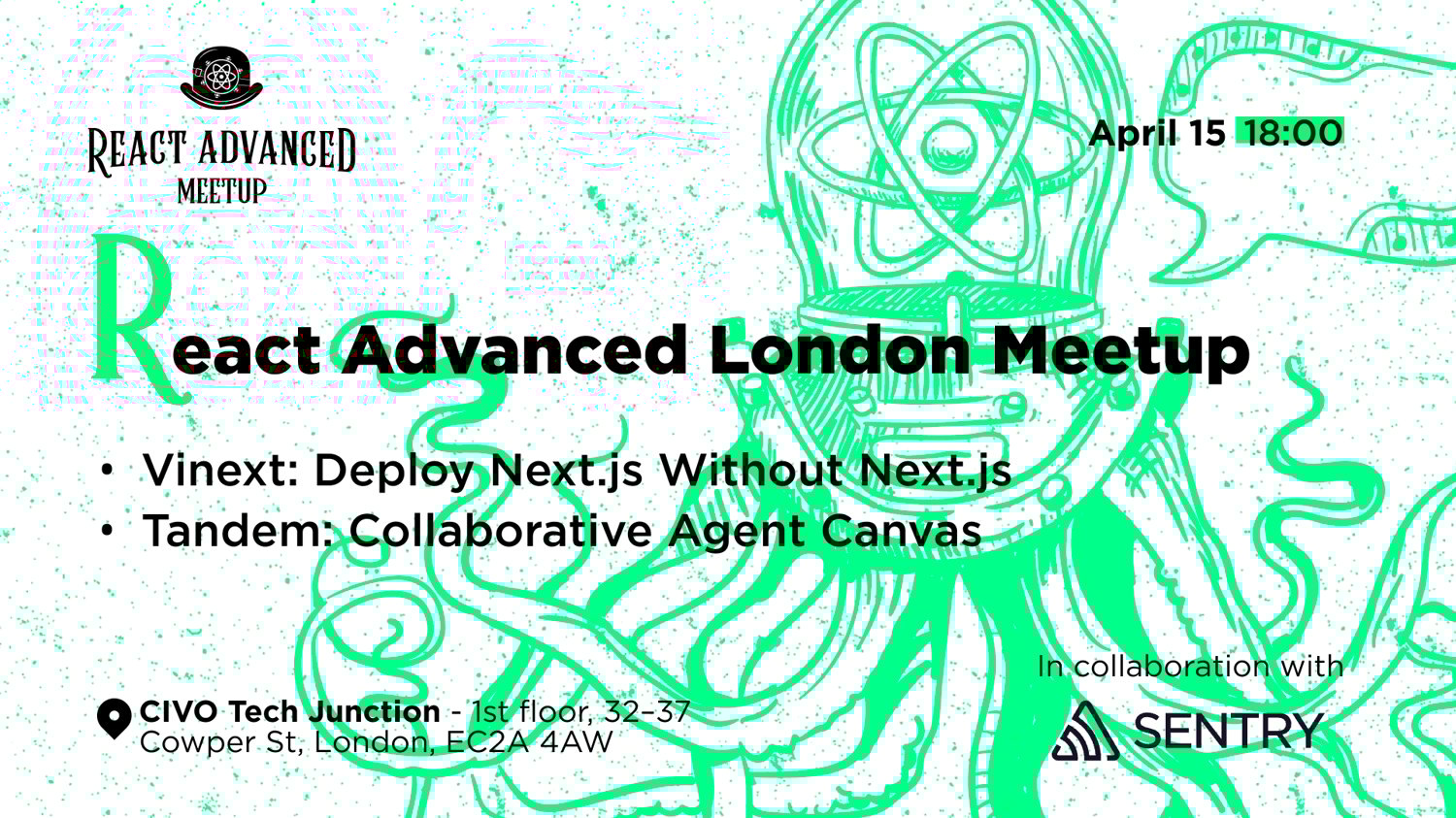

Web Engineering London (React Advanced)
React Advanced London is a community organizing quarterly in-person events and an annual hybrid conference in October.
Engineers of all levels are welcome to join, our meetups are always free to attend and a great place to meet other likeminded people and share some insights about your work and experience from the stage.
Contact email: hi@reactadvanced.com
Want to give a talk at our next meetup? We welcome talk ranging from 5 to 20 min length on any topic related to React and/or React Native, submit them here and we'll be in touch https://forms.gle/rCiQ8Y4jajiC8AHMA
Venue proposal from: https://shorturl.at/FOT34
By joining this group you agree to comply to our Code of Conduct




Platform Sponsors

Torc is a community-first platform bringing together remote-first software engineer and developer opportunities from across the globe. Join a network that’s all about connection, collaboration, and finding your next big move — together.
Join our community today!

Supercharge your dev team with AI code reviews
Get your free trial now
Tandem: Collaborative Agent Canvas
Recently I have been building Menagerie a tool for dispatching many Claude Code agents to complete tasks in parallel while maintaining visibility of progress, status and outputs. agents can show you what they are doing to the web app via playwright and ask for help when the need it.
I think the future of engineering will be based on creating robust agentic systems and amid all the doom and gloom that can exist in the industry these days I want to paint a positive picture of the exciting engineering problems that actually lay ahead of us.
Along with this I'll describe what it has taken me to deploy a system like this, e.g. sandboxing, cursor compatibility, terminals over the network and also how i've made it fun to use (for example you can give your agent a cute avatar, and if you so choose also a top hat)
Web Engineering London (React Advanced)
React Advanced London is a community organizing quarterly in-person events and an annual hybrid conference in October.
Engineers of all levels are welcome to join, our meetups are always free to attend and a great place to meet other likeminded people and share some insights about your work and experience from the stage.
Contact email: hi@reactadvanced.com
Want to give a talk at our next meetup? We welcome talk ranging from 5 to 20 min length on any topic related to React and/or React Native, submit them here and we'll be in touch https://forms.gle/rCiQ8Y4jajiC8AHMA
Venue proposal from: https://shorturl.at/FOT34
By joining this group you agree to comply to our Code of Conduct
Platform Sponsors
Torc is a community-first platform bringing together remote-first software engineer and developer opportunities from across the globe. Join a network that’s all about connection, collaboration, and finding your next big move — together.
Join our community today!
Supercharge your dev team with AI code reviews
Get your free trial now
Get in touch!
hi@guild.host