


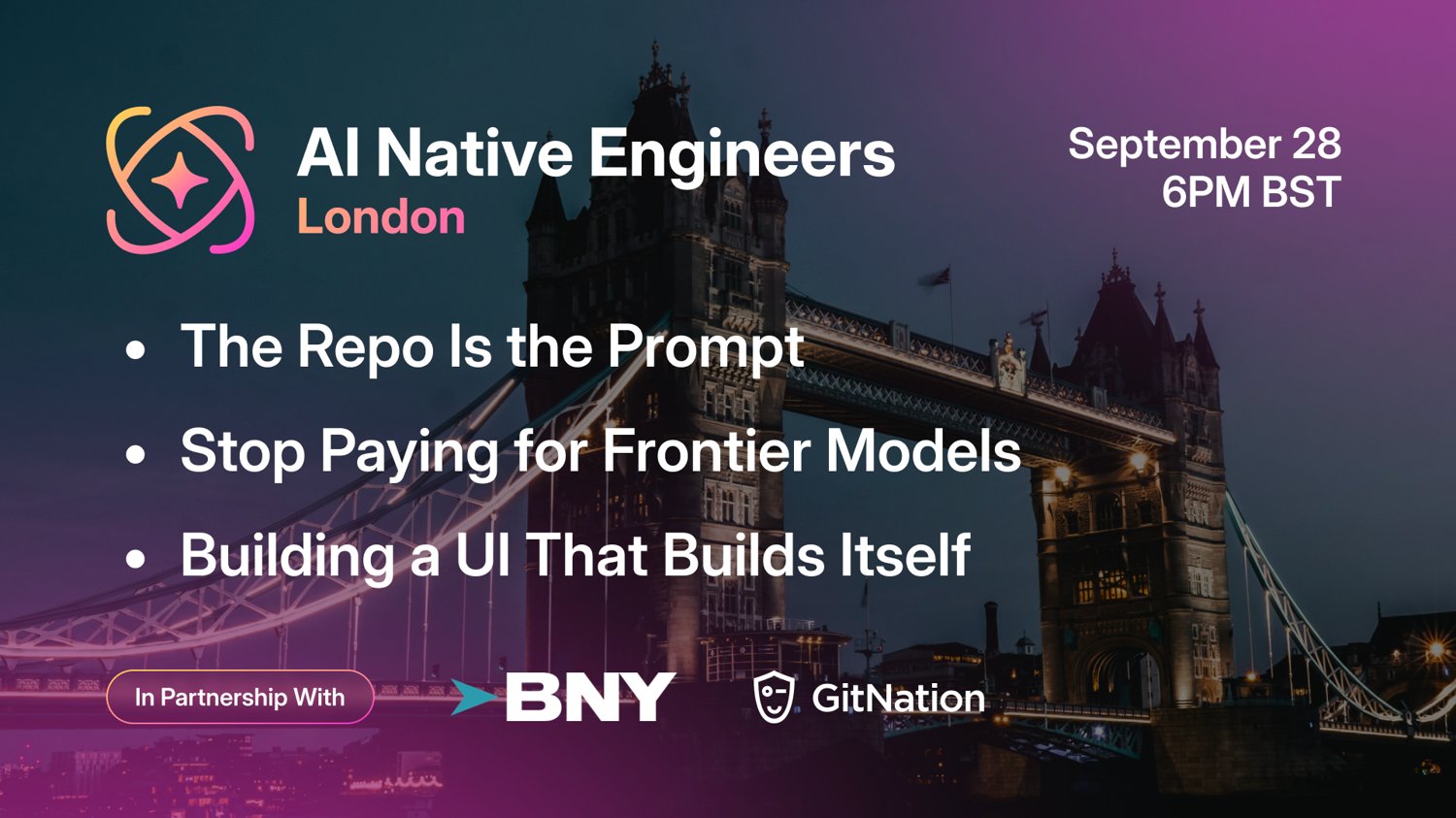
Stop Paying for Frontier Models
Most of use reach for a frontier model by default and pay for it on every call, in latency, in energy, in cash, and in everything that leaves their stack. For most of those calls, a small local model would do the job.
RL Nabors, former Meta/React core team member and AWS alum, covers the vocabulary you need to reason about model performance (capability evals, golden datasets, LLM-as-judge) and walks through real cases: a local agentic harness replacing a frontier call, an in-browser moderation classifier defended with production-trace evals, and a generative summarization feature where the rubric turns out to be harder than the model. You'll leave with a framework for deciding when to choose large and off-prem or small and local models, and how to measure your way to the answer instead of guessing.
You will learn:
- The vocabulary to reason about model performance (capability evals, golden datasets, LLM-as-judge).
- A framework for deciding when a small or local model can replace a frontier one and when it can't.
- A repeatable process for building capability evals from your own production traces, not someone else's benchmark.
- Working examples of using eval results to iterate on prompts and ship with confidence instead of vibes.


AI Native Engineers London
Practical AI for Software Engineers - dev tools in SDLC, core patterns for LLM implementation
AI for Engineers London is a community for software engineers who want to harness AI to build better software, faster.
We focus on the engineering side of AI, not ML/data science, sharing battle-tested approaches, practical tools, and proven patterns that transform how you write, test, deploy, and maintain code today.
Join us for monthly meetups featuring live demos, case studies from London tech companies.
For collaborations, reach events@gitnation.org
Topics covered:
🛠️ AI-Enhanced Development & Delivery
Development Acceleration
Code generation with Claude Code, GitHub Copilot, Cursor, and emerging tools Automated code reviews, refactoring, and documentation generation Test generation and intelligent debugging assistance Building with MCP servers, LangGraph, CrewAI, and agent orchestration frameworks Smart monitoring, alerting, and root cause analysis Self-healing systems and automated incident response 🔧 Practical LLM Integration PatternsLearn proven patterns for adding AI capabilities to your applications without complexity:
Core Integration Patterns
RAG (Retrieval-Augmented Generation): Connect LLMs to your databases and documentation to answer questions using your own data — no model training required LLM optimizations Prompt Templates & Chaining: Structure prompts for consistent outputs and chain multiple AI calls for complex tasks Input/Output Validation: Add guardrails to ensure AI responses meet your requirements — from JSON schemas to content filteringAnd other topics within core theme of the group



Platform Sponsors

Torc is a community-first platform bringing together remote-first software engineer and developer opportunities from across the globe. Join a network that’s all about connection, collaboration, and finding your next big move — together.
Join our community today!

Supercharge your dev team with AI code reviews
Get your free trial now
Stop Paying for Frontier Models
Most of use reach for a frontier model by default and pay for it on every call, in latency, in energy, in cash, and in everything that leaves their stack. For most of those calls, a small local model would do the job.
RL Nabors, former Meta/React core team member and AWS alum, covers the vocabulary you need to reason about model performance (capability evals, golden datasets, LLM-as-judge) and walks through real cases: a local agentic harness replacing a frontier call, an in-browser moderation classifier defended with production-trace evals, and a generative summarization feature where the rubric turns out to be harder than the model. You'll leave with a framework for deciding when to choose large and off-prem or small and local models, and how to measure your way to the answer instead of guessing.
You will learn:
- The vocabulary to reason about model performance (capability evals, golden datasets, LLM-as-judge).
- A framework for deciding when a small or local model can replace a frontier one and when it can't.
- A repeatable process for building capability evals from your own production traces, not someone else's benchmark.
- Working examples of using eval results to iterate on prompts and ship with confidence instead of vibes.
AI Native Engineers London
Practical AI for Software Engineers - dev tools in SDLC, core patterns for LLM implementation
AI for Engineers London is a community for software engineers who want to harness AI to build better software, faster.
We focus on the engineering side of AI, not ML/data science, sharing battle-tested approaches, practical tools, and proven patterns that transform how you write, test, deploy, and maintain code today.
Join us for monthly meetups featuring live demos, case studies from London tech companies.
For collaborations, reach events@gitnation.org
Topics covered:
🛠️ AI-Enhanced Development & Delivery
Development Acceleration
Code generation with Claude Code, GitHub Copilot, Cursor, and emerging tools Automated code reviews, refactoring, and documentation generation Test generation and intelligent debugging assistance Building with MCP servers, LangGraph, CrewAI, and agent orchestration frameworks Smart monitoring, alerting, and root cause analysis Self-healing systems and automated incident response 🔧 Practical LLM Integration PatternsLearn proven patterns for adding AI capabilities to your applications without complexity:
Core Integration Patterns
RAG (Retrieval-Augmented Generation): Connect LLMs to your databases and documentation to answer questions using your own data — no model training required LLM optimizations Prompt Templates & Chaining: Structure prompts for consistent outputs and chain multiple AI calls for complex tasks Input/Output Validation: Add guardrails to ensure AI responses meet your requirements — from JSON schemas to content filteringAnd other topics within core theme of the group
Platform Sponsors
Torc is a community-first platform bringing together remote-first software engineer and developer opportunities from across the globe. Join a network that’s all about connection, collaboration, and finding your next big move — together.
Join our community today!
Supercharge your dev team with AI code reviews
Get your free trial now
Get in touch!
hi@guild.host